

Meet Nyumburu’s new interim director

For Psyche Williams-Forson, Nyumburu Cultural Center’s new interim director for the 2025-2026 school year, a major story that shapes how she interacts with students derives from her freshman year at the University of Virginia in 1983. She came from a rural community, 45 minutes away from Charlottesville, where the university is located.
Walking through the halls of her dorm on move-in day, she began to see that everyone knew each other. Besides a graduate student who was awaiting a new room assignment, Williams-Forson was the only Black student in the dorm.
“The more folks moved in, the more isolated I felt,” she recalled.
Williams-Forson found friends in the school’s gospel choir or hanging out on the quad. Still, her dorm remained a sore spot for her first year. The isolation and anxiety reached a fever pitch when she discovered her roommate had allowed visitors to sleep in her bed when she wasn’t around.
She called the university’s residential services and asked for a new room. According to Williams-Forson, they wouldn’t budge until she pointed out that she was the only Black girl in her dorm. As Williams-Forson recalls, because she applied early decision which allowed her to pay her room deposit relatively early, her housing arrangements were swept up with the university’s legacy housing program. As she puts it, parents would request that particular dorm if they did not want children to interact with other people.
“I tell that story every now and then because I want to remind myself how processes and systems affect people at a very real and visceral level,” she said. “My mission is to think about whatever decision I make, [and] the ways in which it’s going to affect the student who nobody’s even really thinking about.”
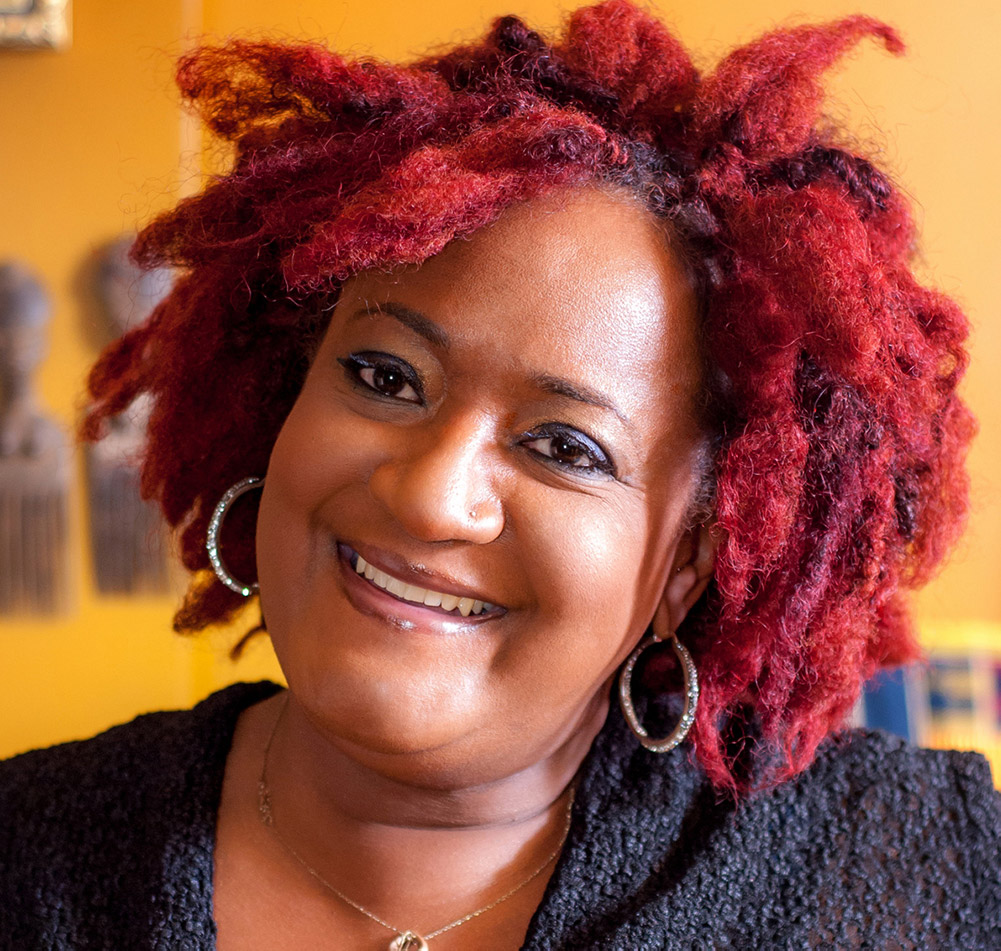
Her time at Maryland began in 1991, receiving her master’s and doctorate degrees in American studies by 2002. A scholar in African American life, William-Forson’s research specifically focuses on food cultures in the South. She has also served as chair of the department of American studies since 2015.
According to Williams-Forson, she was invited to consider the director position by Georgina Dodge, the university’s vice president for Belonging, formerly the office of diversity and inclusion. The invitation follows Ronald Zeigler’s retirement in early August after leading the center for 25 years.
In a statement to The Black Explosion, Dodge said, “I am grateful to Psyche for lending her experience in academic leadership and her faculty perspective to our team for the coming year.”
The transition comes after a nationwide onslaught against diversity programs by the Trump administration since the president’s inauguration in January. In early August, the University of Maryland’s Office of Diversity and Inclusion changed its name to Belonging and Community at UMD.
In March, Zeigler sent an essay to the Nyumburu email list, titled “The Pain of Diversity and DEI: What Can You Do.” The essay raised an alarm about actions at other universities that targeted cultural centers similar to Nyumburu.
Williams-Forson created a distinction between how she felt about the situation and how she will approach it as the new director. The issue is close to Williams-Forson; her parents were very active in the civil rights movement. She referenced her father’s participation in the Farmville, Virginia high school walkout that would lead to Davis V. County School Board of Prince Edward County. This case would be one of the five cases combined into Brown V. Board of Education, which would eventually overturn racial segregation in public schools.
“It’s very disheartening for me to see rights and so forth we fought so heavily for now be in a place where [they are] being reversed and diluted and done away with,” she said.
But, as director, she believes that the survival of the center rests upon being open to concessions and conversation.
“How much can we push back without it jeopardizing [students],” she asked. “Will something be lost? Most likely. Will there be compromises made? To some extent. These are facts of life.”
To her knowledge, there haven’t been any compromises made by the center as of yet.
Williams-Forson intends to follow through with Nyumburu’s mission, which is, as she puts it, “to promote, support [and] showcase the overwhelming lives and histories and accomplishments of people across the African diaspora.”
When asked about how she views her position, William-Forson presented a binary between change and transition. Change happens over time while a transition helps get from point A to point B.
“I’m in this position to help the center move through,” she said. “It is important for all of us to work together so that the legacies and histories that began with this center and the mission of the center will be here in 50 years and more.”
Additionally, when discussing her goals for the center, she emphasized the importance of an interdisciplinary and open approach to the mission. One of these goals is to increase faculty involvement with the center.
“The diaspora of Africans is huge. We’re everywhere,” she said. “We have our hands, bodies, minds, spirits and souls in everything, from science to the letters.”