

AI-generated videos could worsen racism on the internet, experts say

Artificial intelligence companies have promised that their video generation models will make the world a better place, but experts on technology and racism say that their advancements run the risk of perpetuating digital blackface.
Digital blackface happens when non-Black individuals create or use digital depictions of Black people to express or represent themselves, according to Merriam-Webster. These depictions can include GIFs, images, videos, emojis and profile pictures.
People sometimes engage in digital blackface for deception.
“The ability to convincingly perform or mimic a community member does have the potential…to spread misinformation easier,” said Rianna Walcott, an assistant professor of communication at the University of Maryland.
OpenAI, the company behind ChatGPT, claims that Sora and other AI-powered tools will “fundamentally reshape society and accelerate the arc of human progress.”
So far, AI-generated images and videos have only helped flood the internet with content.
Francesca Digiovanni, a freshman environmental science and policy major, says she has seen TikTok posts that display two cooking videos and ask viewers to detect which one is AI-generated.
“Usually it’s not easy to tell,” she said.
“When I go on Instagram and try to search for something, there’s a bunch of stuff by the search bar,” said Maggie Faloon, a sophomore environmental science and policy major. “There’s a lot of AI-generated stuff there.”
This content is created through generative AI.
Generative AI refers to artificial intelligence-powered models that can generate content based on the data they were trained on, according to IBM.
Gen-2, the first publicly available video generation model, was announced in February 2023 by Runway, an applied AI research company. Since then, many other companies have launched their own video generation models, such as OpenAI’s Sora and Google’s Flow, which is powered by Veo 3.1.
Walcott helped her family members and friends detect AI-generated content when it first began spreading in late 2022. Consequently, she was not surprised when that content started incorporating digital blackface.
“A lot of my research lately looks at AI slop [low-quality AI-generated content], particularly the misogynoir [misogyny targeted towards Black women] in some of those generated videos, like [the ones] of Black people fighting,” Walcott said. “This is a pretty inevitable next step to me, unfortunately.”
This combination of digital blackface and AI-generated videos will likely worsen the spread of racist stereotypes.
Some of these videos depict Black teenagers dressed in black streetwear and scowling, perpetuating the idea that young Black men are “dangerous thugs.” Others depict Black female judges wearing bonnets, perpetuating the idea that Black women do not know how to dress in public.
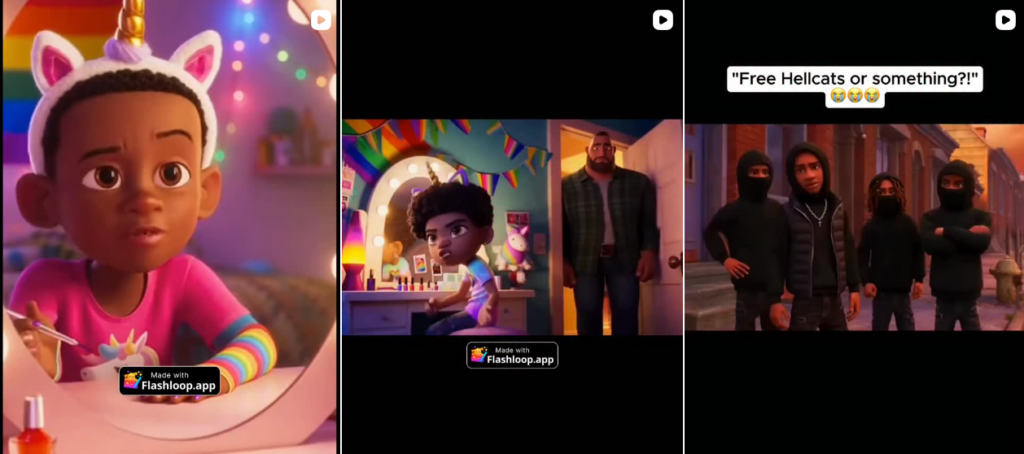
“People will see [racist] content, regardless of the intent of the creator, and think it is real, especially when it confirms their existing biases or fits their narrative,” said Jen Golbeck, a professor at Maryland’s College of Information. “Others will be happy to share it, even if they know it’s AI, because it makes a point that they like.”
Since AI-powered video generators are not regulated tools, racist content is likely to spread without consequence.
“You can see the good in most of the [generative AI] stuff,” Walcott said, “but I’m not really sure where the good is in being able to generate fake Black people.”