

Black talent takes center stage at “Can you pass the mic, please?” event

The Kirwin Hall rotunda pulsed with vibrant energy Friday night as attendees gathered for the first-ever “Can you pass the mic, please?” event highlighting artists from the DMV and celebrating Black History Month at the University of Maryland. Two university student organizations, Young Black Creative and Student Success Media, hosted the event.
The rotunda was filled with paintings, photographs and vendors selling their art. The center of the rotunda acted as a stage for live performances to come later in the night.
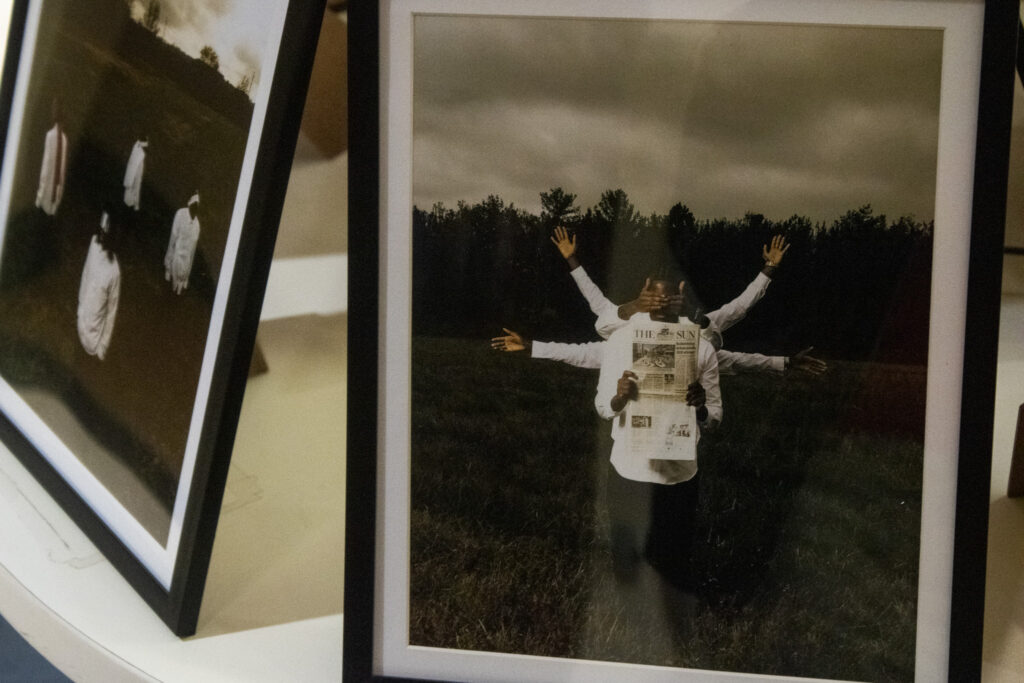
Mikhi Kelly, a photographer, exhibited his work “Smokey Mirrors”, inspired by the introduction to Don Miguel Ruiz’s “The Four Agreements.” Ruiz’s exploration of the concept of reflections and limiting beliefs resonated with Kelly.
“We’re all reflections of light,” Kelly, a graduate of the Robert H. School of Business said. “But sometimes it’s hard for us to see our own reflections, or the reflections of others because there’s smoke in between our mirrors. Often, that smoke comes from fear, limiting beliefs or childhood trauma.”
Beyond visual artwork, musical artists also shared their talents as the sounds of Afrobeats pulsed through the rotunda. Julion Harris, a senior business management and marketing double major and Emcee, introduced artists.
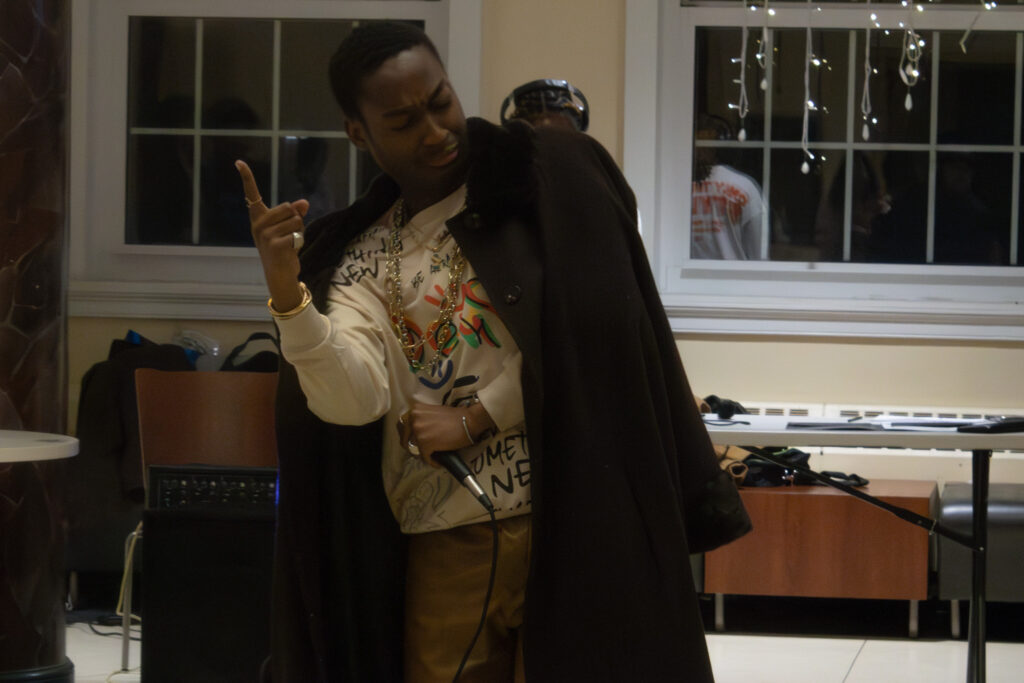
Ayo Seriki, an Afrobeat musician and Maryland alum, emerged from the audience to sing his original song, “Let’s take a peek inside my mind.” Seriki moved around the room as he sang and engaged with the audience.
“People are singing their own struggle every day…but the confidence, the way you own it pushes it to the next level,” he said.
Seriki began experimenting with trap music during his sophomore year of college and was encouraged by his cousin to make beats. He performed twice at Nyumburu Cultural Center’s annual homecoming Juke Joint during his time at this university.
After Seriki, more spectators of the show took the stage to perform, such as Chavannah Green, a freshman business management major and En’rage model, a Maryland modeling team.
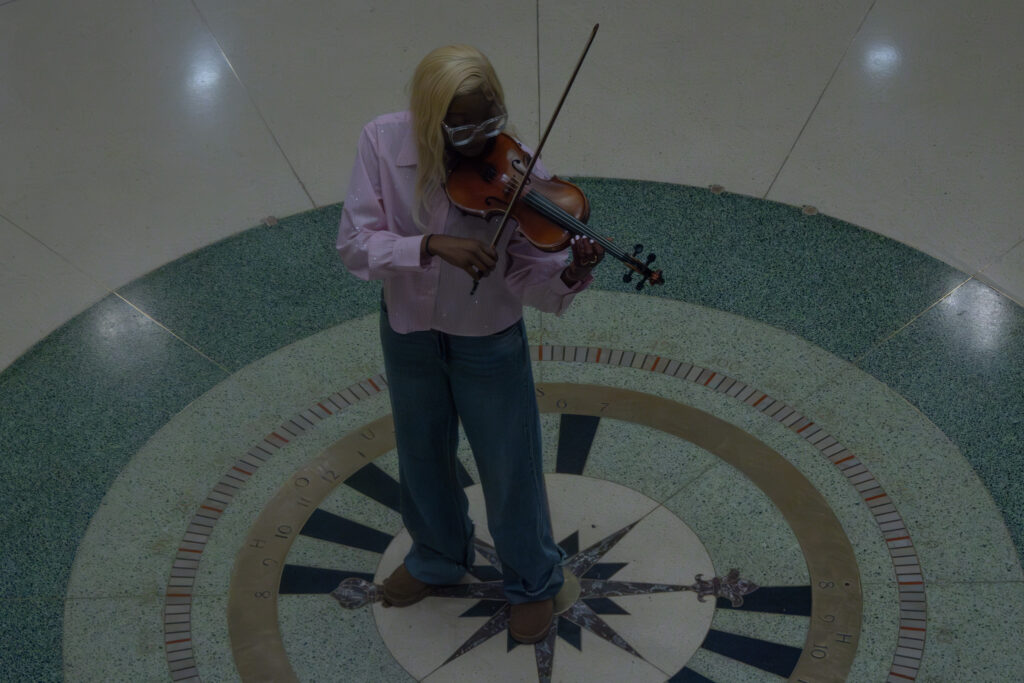
Green performed “Love” by Keyshia Cole and the crowd held back from singing and chose to hum under their breaths.
Emcee Harris said he heard the humming to Green’s instrumental of Cole’s classic so he replayed the song and told everyone to sing along. The room erupted in a sing-along with friends and lovers hugging each other.
Then En’rage Models brought theatrical flair to the runway as they strode through the rotunda. Music flowed through the room as En’rage models Green and Rania Bien-Aimé, a senior public health and pre-med student at the university, put on a cupid-themed performance with bows and arrows.
After walking the runway, Bien-Aimé recited “Cocoa Butter Skin,” an original poem she wrote in 2020 during protests following the murder of George Floyd and her move from Cape Cod, Massachusetts. Bien-Aimé described growing up Black in Cape Cod as bittersweet.
“It’s almost like you’re in a zoo sometimes,” she said. Bien-Aimé described questioning her identity as a young Black girl in a predominantly white community.
“I was like, God, why did you make me like this? You could have made me lighter, you could have made me light-skinned, you could have made me like my Brazilian friends, you could have made me white. Why am I like this?” Bien-Aimé said.
In 2020, she did a lot of reflection on what it meant to be Black and beautiful.
“Because when you’re not used to seeing Black people or Black people are not used to feeling as beautiful, it’s easy to see that with yourself and not see yourself as beautiful,” Bien-Aimé said.
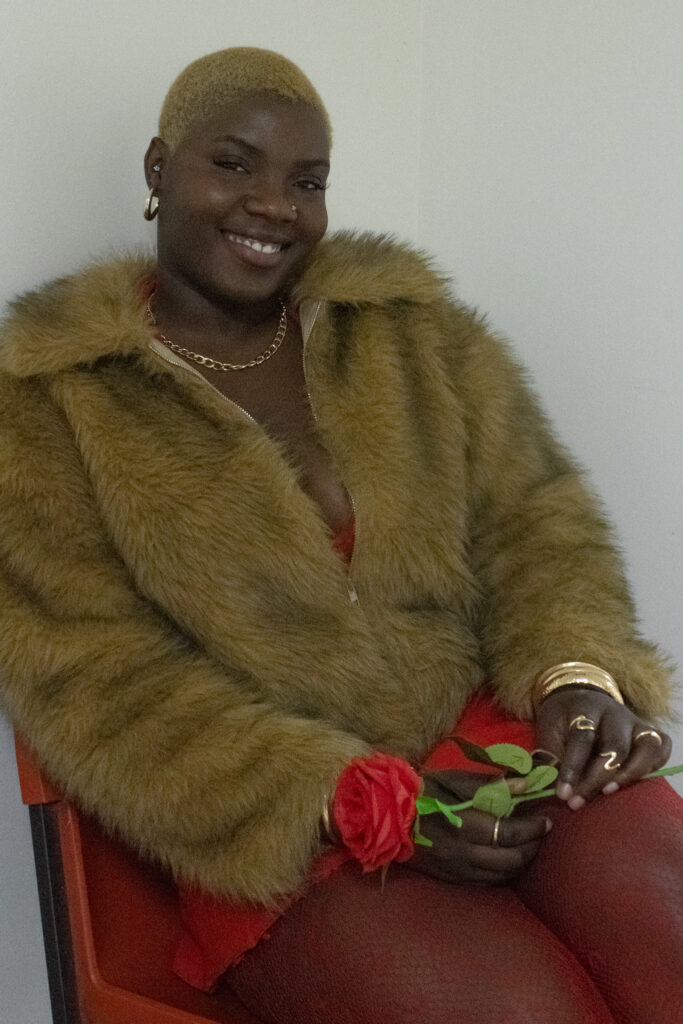
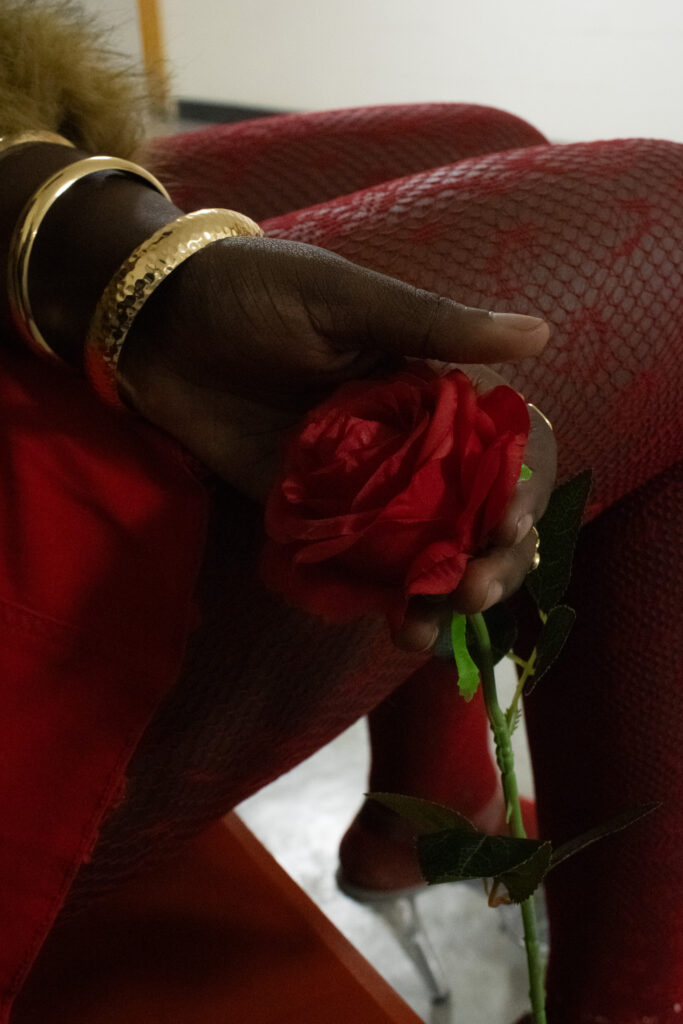
Rania Bien-Aimé after her performance and interview with the Black Explosion at Kirwan Hall at the University of Maryland on Friday, February 13, 2026. (Princess Tatsi / The Black Explosion)
The themes of identity continued as Xavier Perry, a sophomore history and social studies education double major, stepped onto the stage. The rotunda was silent as he recited a poem about revolution.
Perry said that there were no settlers or natives before colonization, only people.
He described colonization as a force that reshaped identity into something “complacent, controllable and depressed”.
“Decolonization is when you truly liberate yourself, starting from your mind,” he said.
Perry reflected on performing, saying he loves to share his work because it helps stimulate the process of writing.
“It’s been really enjoyable to see all these different performances through modeling, music or spoken word. It’s amazing to see all the talent we have at our school within our community,” Perry said.
Maryland alum and local musician, Will Kobus, concluded the festivities with a musical performance and the presentation of a series of photographs. The photos documented his first time working with clay.
Kobus described collaborating on the showcase as rewarding.
“My name’s on the [flyer], but I don’t want this to be centered around me,” Kobus said. “This is really about everybody and celebrating the art community we have here.”
The sense of collective celebration is something that resonated with audience member Duna Esuola, a junior finance major and fan of hip-hop and R&B. She said it made her happy to see local artists take the stage.
“There’s so much Black talent in PG County, and it’s great to see this event give them a platform to show their music and actually get a chance to shine and, you know, connect with other people,” she said.