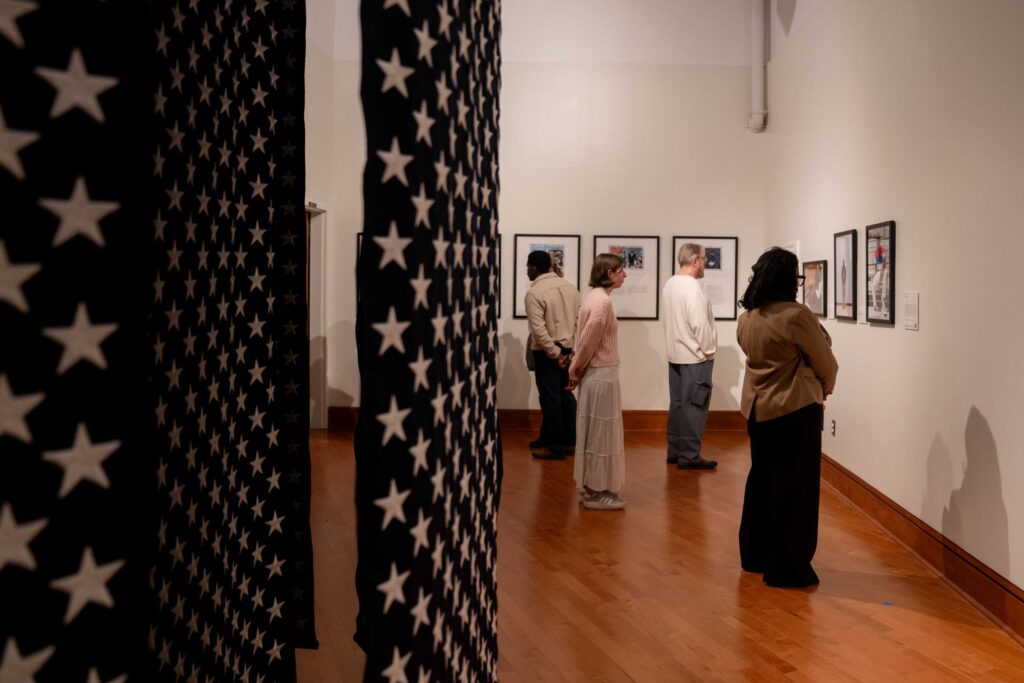
Driskell Center’s “America Will Be!” explores U.S. flag’s complexities

The University of Maryland’s Driskell Center unveiled its spring semester exhibition, “America Will Be!” which examines the U.S. flag’s capacity to serve as both a symbol of pride and protest, opening the campus to political discourse.
The exhibition, on view until May 8, is timed to coincide with America’s 250th anniversary as a nation. Over 20 objects, artworks and documents centered around the theme of the U.S. Flag are on display, according to a press release from the Driskell Center. Langston Hughes’ poem “Let America Be America Again” inspired the title.
Hughes’ poem contrasts the realities of American life and the American Dream. He critiques America for having ideals that it doesn’t uphold, like freedom and equality for all people. The pieces in the exhibit reflect this narrative, contributing to the broader ways communities and the artists themselves deal with loyalty to the country, community and themselves, the press release said.
This exhibit comes at a time when Congressional Democrats accused the Trump administration Feb. 10 of using America’s 250th anniversary as an excuse for private and public partnerships to rewrite history and remove displays related to diversity, equity and inclusion at U.S. National Parks, according to the Associated Press.
“There’s always been a real political, material, aesthetic investment in the flag,” said Jordana Saggese, director of the Driskell Center. “And one of the things we wanted to really show with the exhibition is that this is something that we encounter in the United States in everyday life.”
Saggese, who is also a professor in the Department of Art History and Archaeology and co-curator of the exhibit, said that she began discussing the idea that became the exhibition centered around the U.S. flag back in 2018 with Nicole Archer, who teaches at Montclair State University.
They attended an exhibition together at the National Museum of Women in the Arts. One room featured a retrospective of Sonya Clark, a local textile artist, centered on her engagements with U.S. and historical flags, according to Saggese.
“Nicole and I were really intrigued by Clark’s engagement with the symbol of the flag, but also the material of the flag,” Saggese said. “And so in that conversation, we started to think about other artists, particularly artists of African descent living in the United States who similarly were engaging with the symbol or the image of the U.S. flag.”
Saggese said that when she became the Driskell Center’s director in 2023, she and Archer began putting together their checklist and pursuing loans from other individual institutions to support the exhibition theme.
“This is something that we started working on before the presidential election, and continued to work on after, knowing that although the materials and concepts hadn’t changed or shifted, that maybe the resonance and the impact of those materials would change,” Saggese said.
Some of the central works in the exhibition include David Hammons’ “African American Flag,” which uses the colors of Pan-African unity and applies it to the stars and stripes, as well as June Edmonds’ “Four Years in the White House Flag.”
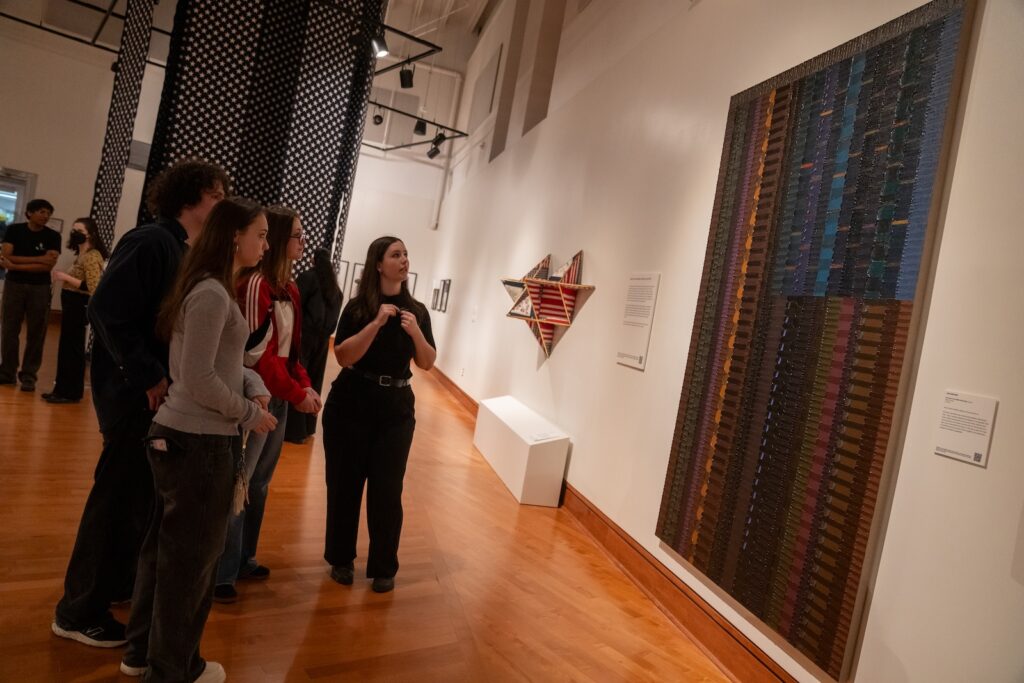
Edmonds, a Los Angeles-based artist, said that her work was named after Elizabeth Keckley, Mary Todd Lincoln’s seamstress.
“She worked in the White House the whole time and was a very successful seamstress in Washington, D.C.,” Edmonds said. “People would confide in her and tell her things. And so she wielded kind of a lot of power, not only because of her status as a successful African American woman, but because she knew things as well, and so that particular flag was dedicated to her.”
“Four Years in the White House Flag” is part of a series of flags Edmonds started in 2019, inspired by a dream she had while living in the South during a residency.
Edmonds said she hopes exhibition visitors contemplate the works on display and get in touch with their own creative processes to help come up with new ways to move forward.
“We are all experiencing history right now,” Edmonds said. “My hope, my expectation … is that the students at the school are having the conversations and that the artwork supports the conversations.’
The Driskell Center held an exhibition preview and opening reception on Feb. 6. Saggese asked Sheldon Scott, a Washington-based artist, to perform at the reception. Scott created a commissioned object that will be on display at the Driskell Center this week, Saggese said.
“The most attractive element to this process and this experience was the opportunity to present this idea that the United States of America is not a static concept,” Scott said. “And I think personally there’s this unrealistic marriage to this concept of America to be something, and it fits very well with the poem that inspired the name of the exhibition.”
The object is a 250-square-inch flag pierced from fabric resembling a dress pattern. The piercing leaves an indelible mark for each and every thread, according to Scott.
“It’s going to be unpolished in that way we find,” Scott said. “But the importance there is to understand that … this is a much more accurate reflection of what the country is than the dominant figuration of what we see out here.”
Scott said that he hopes students leave the exhibition thinking about the United States differently, and see it as a gateway to a deeper understanding of this country, its composition and progression.
“I hope that people come to understand that when I talk about this process, the United States is just turning 250-years-old. It’s still very young,” Scott said. “What I think is important about that is that you have to understand that a toddler does not aspire to crawl.”