

University System of Maryland’s Board of Regents Declared Guilty at Informal Trial
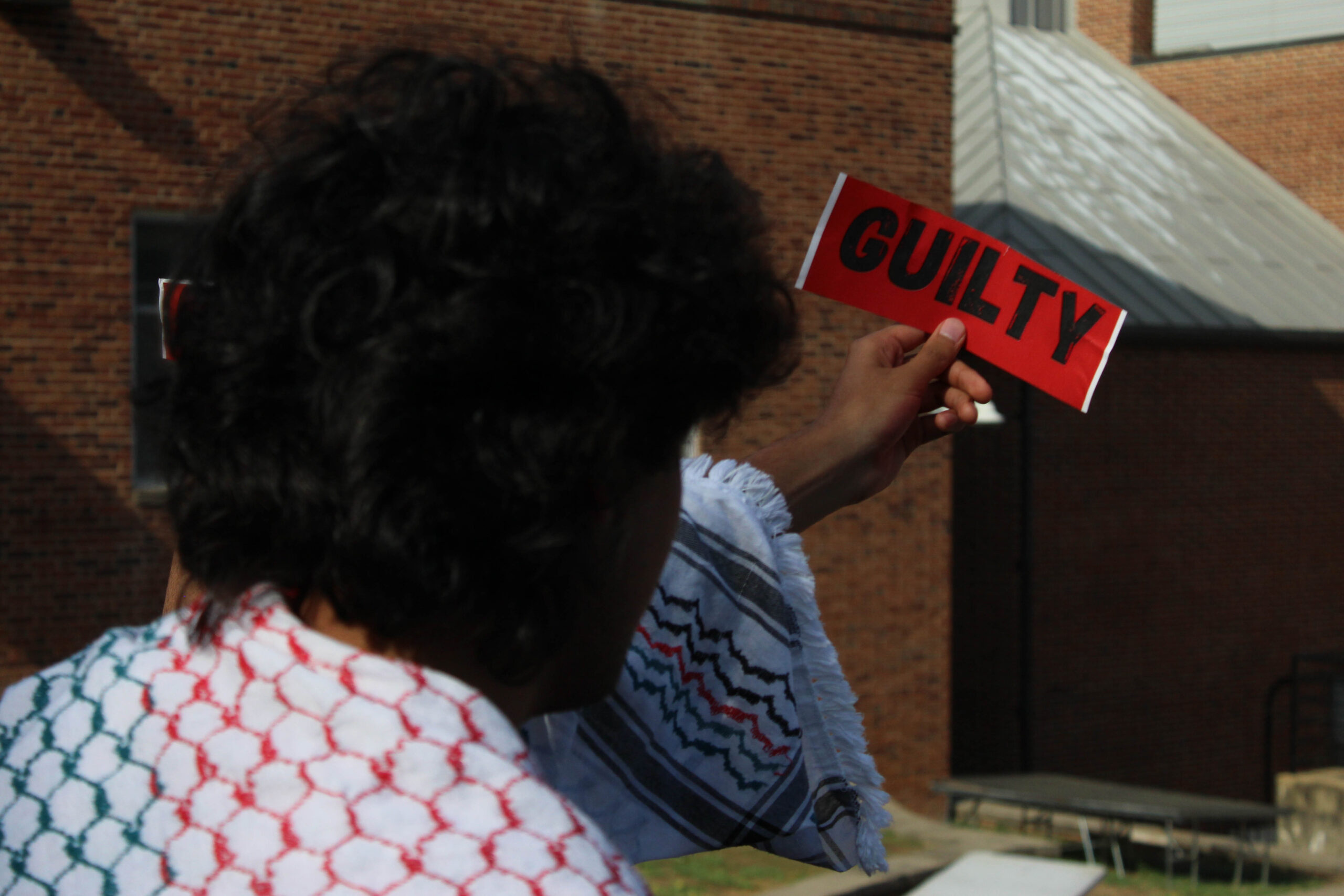
Guilty on all six counts.
Those are the verdicts returned by the University System of Maryland People’s Tribunal on Friday afternoon, an unofficial student-run trial that sought to hold USM’s Board of Regents accountable for various alleged actions, including complicity in genocide.
The six counts in question were financial complicity, academic complicity, military research, institutionalized Zionism, political repression and donor influence, according to the USM Divestment Coalition for Palestine. The coalition ran the event along with the UMD, University of Maryland Baltimore County and Towson University chapters of Students for Justice in Palestine.
Friday’s trial is a part of fights across the university system for divestment from groups complicit in the Palestinian conflict, as well as other conflicts around the world, according to Zyad Khan, a senior computer science major.
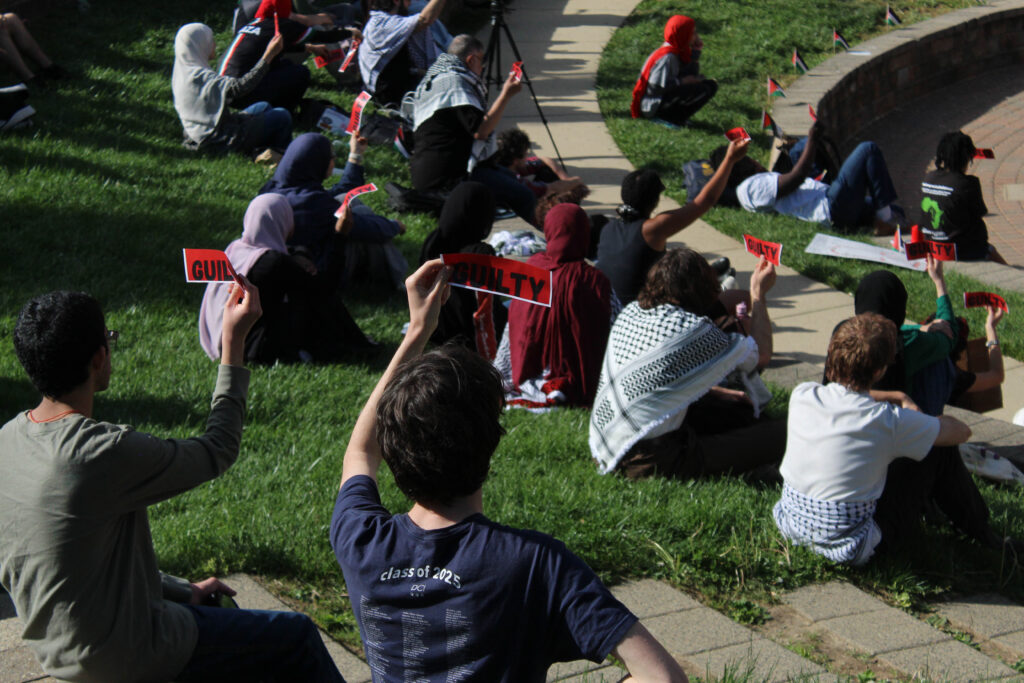
Students and community members from various Maryland institutions gathered in the Nyumburu Amphitheater for the trial.
“We affirm that truth and accountability are not determined by a formal court,” Saad Ijaz, a sophomore government and finance major at UMD, said during the hearing. “They are not determined by the Board of Regents. They are not determined by the U.S. Congress, but the right of the people themselves.”
The tribunal followed the USM Divestment Coalition’s testimony at the Board of Regents meeting that morning, where the group chanted and provided public comment.
“We support our students and their right to express themselves about issues that are important to them,” said Michael Sandler, USM vice chancellor for communications and marketing. “At the same time, the Board of Regents has a responsibility to attend to the system’s business and conduct meetings without disturbance.”
Mohammad Abukhdeir, a sophomore bioengineering student, went into depth on the specifics of the charges, saying that the system invests in companies like Lockheed Martin that create weapons that kill Palestinians.
He also stated that the system allegedly gives “ideological cover” to Israel by inviting Israeli soldiers and politicians to campus, maintaining an Israeli studies program and relationships with Israeli universities. He said that the system provides a research pipeline to groups that create things like weapons and surveillance tools used on Palestinians.
Other allegations included that the university system uses its influence to uphold Zionism at both the university and state level, and that it politically represses students using anti-demonstration policies through banning chalking and amplified sound.
“History teaches us that institutions complicit in atrocities do not reform themselves,” Abukhdeir said. “They must be confronted by the people that they claim to serve.”
The hours-long event included testimonies from students, experts and others, as well as a discussion with students from across the USM talking about the political repression they faced at their schools.
Sarah Edwan, a junior information science major, read testimonies from Palestinian students. Edwan was emotional as she read the story of a student’s friend, who was killed when she was 16. Edwan read another story about a family that was forced to evacuate to southern Gaza.
At the end of the event, Ijaz, dressed in a judge’s robe, asked the dozens of people present to raise red slips of paper if they found the board guilty of each charge. They did so, unanimously, for each of the charges.
“The so-called Board of Butchers is hereby found guilty—guilty of complicity, guilty of negligence in the face of overwhelming moral evidence, guilty of prioritizing profit, power, political alignment over human life and dignity,” Ijaz said.
Afterwards, Ijaz said the tribunal demands that the board divest from anything complicit in violence, genocide and oppression, and that the board of unelected members is dissolved.
“I think they will hear this,” Khan said of the Board of Regents. “They will hear what was talked about today, and it is their choice whether or not to take action, if they would like to remain complicit in this and continue to want to be individuals that deserve to be put on trial for their inaction.”