

“Unprecedented,” inside the SGA election tickets disqualifying violations
RollTerps Presidential Candidate, Peyton Steinberg, released two reports from the Student Government Association’s election commission that led to the disqualification of the two major tickets in the 2026 election.
The governing body responsible for advocating for the University of Maryland’s undergraduate students will go into the summer with only two elected officials out of 29, despite the 3,044 student votes.
In an April 21 email to undergraduate students, the elections commission announced a special election this fall to fill the 27 vacant seats and the formation of a committee to ensure continuity in the interim.
Steinberg released the reports to the SGA general Slack channel on Tuesday.
“It shows [JusticeUMD was] a non-rule-abiding ticket from the beginning,” Steinberg said in a statement.
JusticeUMD provided The Black Explosion with the report by the commission dated March 11. The report details the commission’s rationale for its penalty and sanction. The ticket declined to release the report for other violations, citing privacy concerns.
JusticeUMD Presidential Candidate Amira Abujuma and Vice President of Financial Affairs Candidate Nick DiSpirito provided their account of the actions that led to the four violations in this year’s election.
Full reports are linked to the header of each section when available.
Violation 1: JusticeUMD – Campaigning Prior to the Official Start of Campaigning
Petitioned by RollTerps – Two-day active campaigning freeze – 60-point penalty
JusticeUMD’s first violation, worth 60 points, came from an October Instagram post condemning an on-campus event with Israel Defense Force soldiers held by this university’s Student Supporting Israel Chapter, according to a report from the elections commission shared by JusticeUMD.
JusticeUMD’s 2026 campaign was unique because the ticket shared a name with a ticket in the 2025 election, effectively rerunning the ticket.
“The ticket chair that ran the ticket last year wanted to create another ticket this year and just decided to go with the same name,” Abujuma said in an interview last Wednesday.
According to The Diamondback, JusticeUMD’s 2026 College of Agriculture and Natural Resources candidate, Diego Henriquez, was the ticket chair in the 2025 election. Election finance report records show that Henriquez prepared JusticeUMD’s records this year, a responsibility delegated to a ticket’s chair per election rules.
He’s one of two 2026 JusticeUMD candidates who ran in 2025. The other 22 candidates on the ticket were running under JusticeUMD for the first time.
Henriquez did not respond to a request for comment.
JusticeUMD was a collaborator, or co-author, on the Instagram post condemning the Students Supporting Israel event, according to UMD’s Students for Justice in Palestine chapter. The original JusticeUMD account has since been deleted.
In the report, the commission says that JusticeUMD’s reputation for campus advocacy violates Article II of the SGA election rules and regulations, which details that a ticket’s existence must be based on the SGA election cycle. The commission also argues that because the 2025 and 2026 JusticeUMD campaigns have the same ticket chair, Instagram account, ticket name, stylization and goals, the 2026 ticket is responsible for the violations of the 2025 ticket.
Abujuma pushed back on the ruling.
“[The post] mentioned nothing about SGA elections. It mentioned nothing about voting,” Abujuma said. “They just simply had an Instagram account with a lot of followers and a lot of influence, and wanted to use that to continue advocacy work.”
The report acknowledged that the ticket “didn’t seem to intend to garner support among voters, but rather aimed to spread awareness about an issue affecting students,” as a reason behind its 60-point valuation. Early campaigning can carry between 50 and 99 penalty points, according to the election rules.
Abujuma claims that before filing, the ticket had unofficial correspondence with the elections commission to determine whether or not rerunning the ticket would result in violations. The violation ruling came nearly two weeks after the ticket registration deadline.
Head Elections Commissioner Leonard Fomin said the commission only becomes aware of a ticket’s intention to campaign when it registers. According to him, the elections commission isn’t responsible for ensuring registered tickets aren’t campaigning early.
The violation resulted in a two-day campaigning suspension for JusticeUMD from March 23 to March 25, and required that the ticket restart its Instagram account from 0 followers.
“The only appropriate course of action to ensure fairness across the cycle is to remove active campaigning time from JusticeUMD,” the report read.
It was the first 60 out of 100 points required to disqualify the ticket.
Violation 2: JusticeUMD – Campaigning in Bad Faith
Warning letter – 15-point penalty
The Black Explosion has not been able to verify information about JusticeUMD’s second violation.
DiSpirito said that violation was caused by an interaction between a RollTerps and JusticeUMD candidate during the ticket’s two-day suspension. The ticket did not provide the commission’s report for the violation.
RollTerps declined to comment.
Violation 3: RollTerps – Ticket collusion done in bad faith
Petitioned by JusticeUMD – Disqualification – 100-point penalty
RollTerps’ disqualifying violation was because of a text sent by a ticket member to a JusticeUMD member, according to the redacted version of the commission’s report released by Steinberg.
According to the report, the key communication that led to the violation read:
“I want to figure out a way to keep [redacted] eligible to run if yall really really didn’t know what was happening, but I need to talk to you about it.”
“A candidate who attempts to assume the powers of the [c]ommission is inherently undermining this authority of the elections activities, campaigning environment, and administration,” the report read.
In an interview last Wednesday, DiSpirito said RollTerps members texted him to prevent sanctions against him and Abujuma in connection with an antisemitic YiKYak post.
According to DiSpirito, the weekend before voting began, a post allegedly targeting a Jewish individual circulated on the anonymous social media platform, YikYak.
UMD President Darryll Pines sent an email on March 30 notifying the school community of an active investigation into an alleged antisemitic hate crime.
The email ended by noting the start of SGA voting and emphasizing that the elections “must take place according to applicable policies and procedures, while prioritizing the safety of our campus community.”
Steinberg said that the email was in reference to a “hate crime incident” in which a RollTerps member was the victim.
“For something like that to happen over student government is, in my opinion, just appalling,” Steinberg said.
DiSpirito said that a member of RollTerps attributed the post to JusticeUMD.
JusticeUMD denied any connection to the post.
DiSpirito said that a member of RollTerps attempted to contact him over the phone, which he believed violated election rules. DiSpirito asked not to be contacted and to direct concerns to the elections commission.
According to Fomin, the commission advises tickets to limit contact in-person and online to avoid violating the election rule against resource sharing.
DiSpirito said he was contacted about the situation by other RollTerps members and uninvolved individuals, including a College Park City Council member. Abujuma and DiSpirito are former student liaisons with the council.
“Make no mistake, [a RollTerps member] tried to disrupt the electoral process by trying to engage in collusion,” DiSpirito said.
The involved RollTerps members declined to comment.
DiSpirito maintained that the ruling to disqualify the whole ticket was unfair.
“If they’re going to disqualify people, disqualify the people involved,” he said. “I’m sure there’s members on [RollTerps] that were not aware of [the actions], and it’s not fair to them either.”
In the report, the commission said punishment of the entire ticket “is fundamental to the purpose and operations of the election’s rules.”
Violation 4: JusticeUMD – Campaigning Prior to the Official Start of Campaigning
Petitioned by RollTerps – Disqualification (via points) – 90-point penalty
JusticeUMD’s disqualifying violation involved conspiring to influence the election in its favor through a December SGA vote on the 2026 election rules, according to the report released by Steinberg.
The decision was based on screenshots of a group chat with members of JusticeUMD. Abujuma said a former JusticeUMD member sent the messages to the elections commission.
“I won’t lie, when I first saw those screenshots, I was in shock, like ‘Wow, this looks terrible,’” Abujuma said. “But then once I actually got the context, that when I realized ‘oh, okay, this was not the intention at all.’”
The specific aspect of the election rules JusticeUMD conspired to pass was eliminating residential representative seats from the legislature, the commission said in the report.
The text messages appear to argue that the 2025 ticket won a majority in the legislature because of the amount of positions it could fill in the election. The sender believed that voting to reduce the number of seats would protect JusticeUMD from “zionist” challengers in 2026.
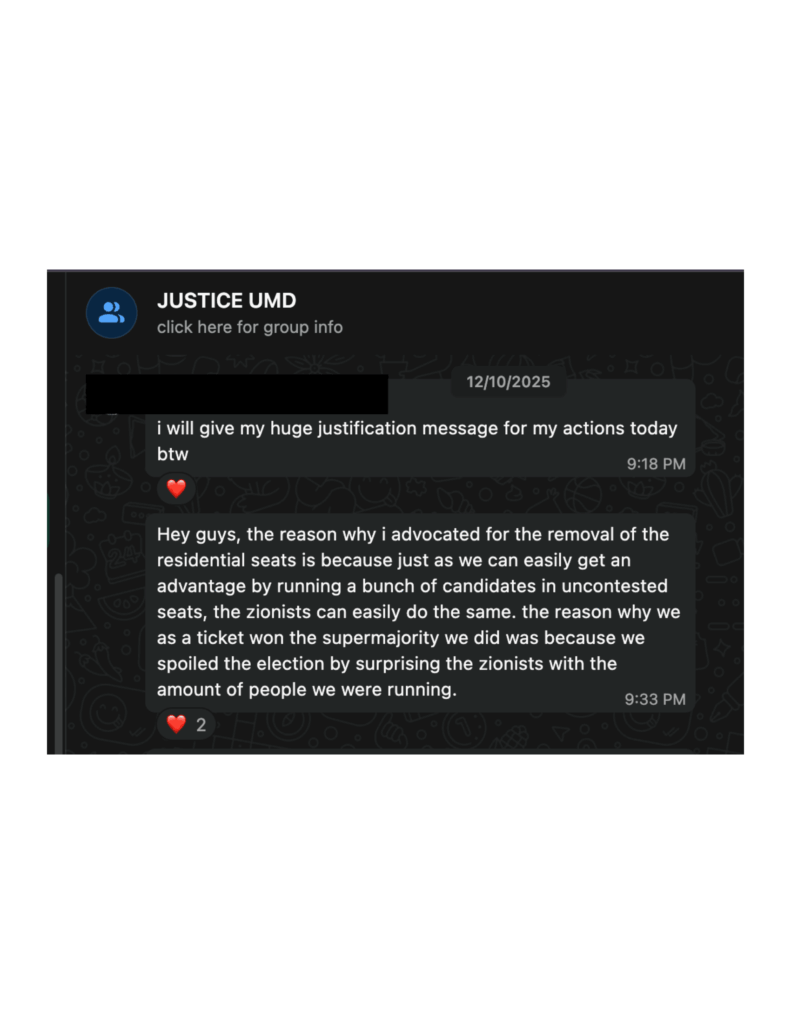
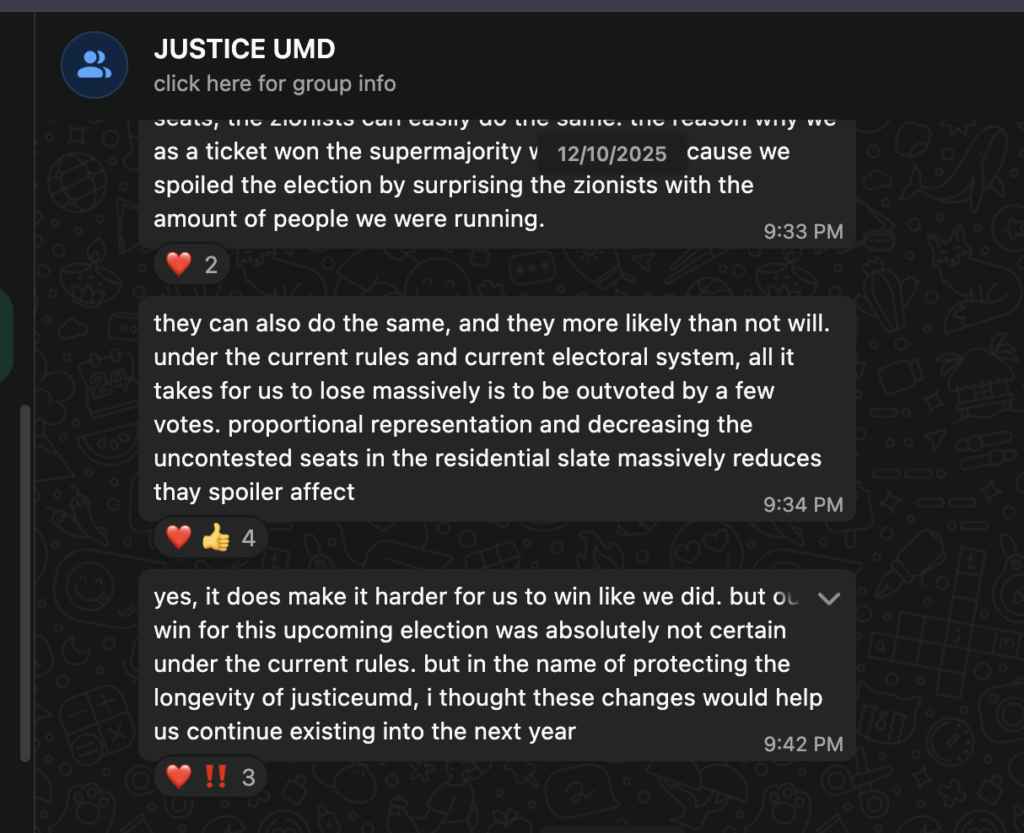
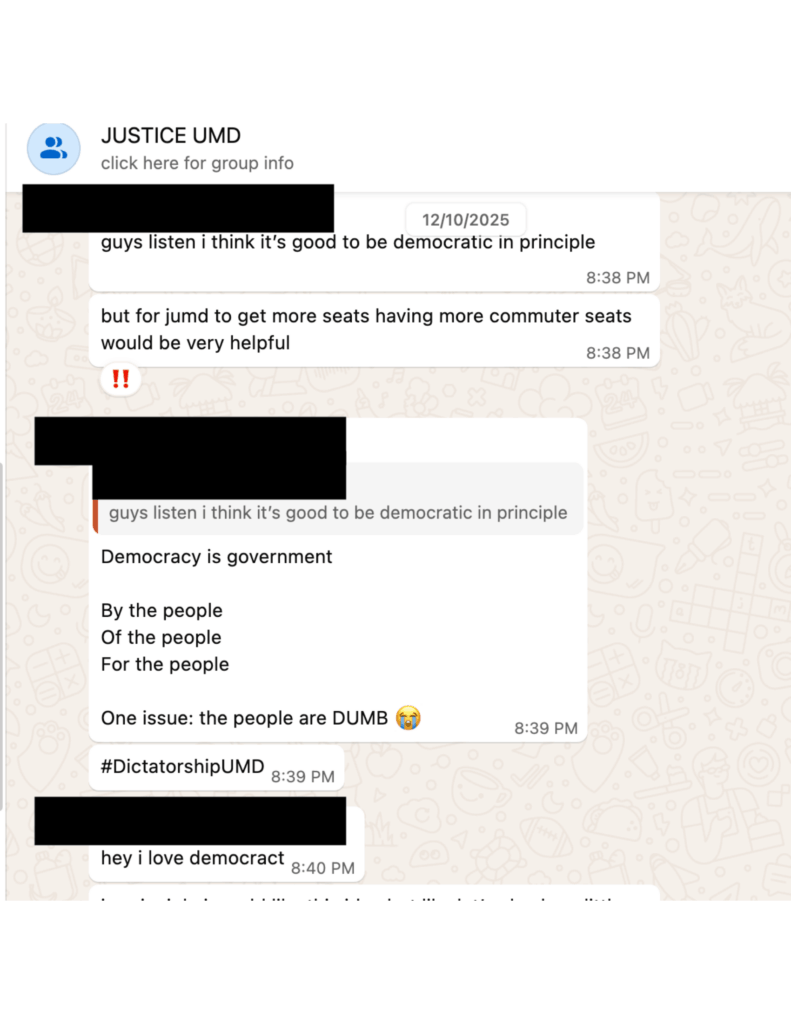
Text messages from a JusticeUMD group chat in December 2025. Referenced as “Upcoming Elections #2” in the report.
Five of 23 candidates on the 2026 JusticeUMD ticket are members of the SGA legislature.
Abujuma, who is not a member of the SGA, argued against the violation, stating that eliminating representatives wouldn’t have helped the ticket. She also said the messages themself shouldn’t be considered campaigning.
In the report, the commission said that “the fact that this vote was coordinated specifically to benefit JusticeUMD” was reason enough to consider it active campaigning.
Privacy and Publication
The commission published minimal information about the violations committed by each ticket. The public tracker lists the violations, decision date, liable ticket, point penalty, sanction and appeal status.
The commission cited the Family Educational Rights and Privacy Act to explain why it hasn’t published further information about the violations. According to the Student Press Law Center, the act withholds federal funding from educational institutions that release “education records” without the consent of the student.
The legislation defines education records as records that are directly related to a student and are “maintained by an educational agency or institution or by a party acting for the agency or institution.”
In a statement to The Black Explosion, Fomin, the head elections commissioner, said SGA generally avoids publicizing personally identifying information that could lead to doxing or other privacy concerns.
According to him, there are no formal rules preventing candidates from disclosing information. The election rules state that all rulings from the commission are sent to “every candidate impacted in the rulings.”
What now?
All members of the disqualified tickets will be barred from campaigning in the fall special election.
A continuity committee composed of the Head Election Commissioner, Fomin, Chief Justice Graham Firsoz and Treasurer Ben Nathan, will act as liaisons and spokespeople for the SGA, in consultation with the SGA advisors. It will not make policy decisions.
The vice president for student affairs will authorize how financial and organizational operations proceed during this period. A finance operations group composed of students formed through the Student Organization Resource Center and SGA advisors will support the financial processes over the summer.