

Bubbles and pride, UMD celebrates emancipation
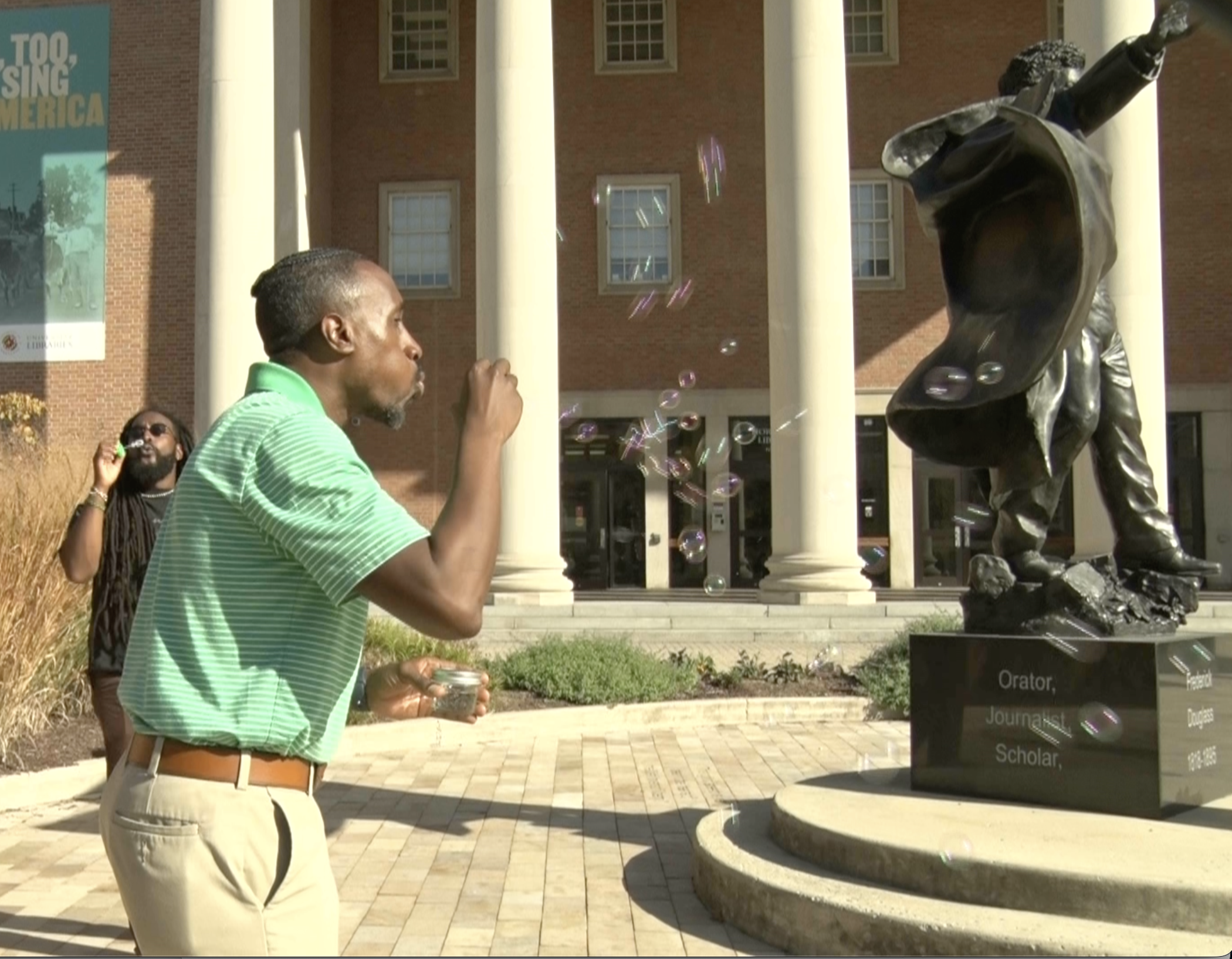
About a dozen people gathered near the Frederick Douglass statue outside the University of Maryland’s Hornbake Library last Wednesday, blowing bubbles and dancing to a recorded speech honoring Black ancestors and their struggles for freedom.
The 30-minute interactive performance, titled “Bubbles + Black Questions: a Performance Provocation,” invited participants to reflect on Black history, identity and the meaning of liberation during Maryland Emancipation Day. The event was open to everyone but primarily intended for the university’s Black community.
Maryland Emancipation Day was Nov. 1 marking the day in 1864 when slavery was abolished in the state.
Participants began by gathering in a circle and discussing the significance of Emancipation Day, sharing thoughts about Black pride, Black excellence and the importance of recognizing those who came before them.
The performance then moved into an interactive experience. As music played in the background, a recorded voice spoke about ancestors who paved the way for future generations and continued to watch over them. Participants responded through interpretive dancing, blowing bubbles and sitting quietly as they listened.
Jess Valoris, a Masters of Fine Arts student at UMD who organized the event, said the performance was designed to bring attention to the questions Black artists have raised throughout American history.
“Bubbles + Black Questions” reflected an invitation for Black people to consider how those questions challenge the way America understands freedom and liberation, she said.
“When I think about the legacy of liberation and all of the movements for different forms of abolition and liberation in this country, all of that is really rooted in their struggles,” Valoris said mentioning the 33,000 emancipated Black slaves in Maryland.
Holding the performance near the statue of Frederick Douglass was also intentional. Valoris said Douglass was a figure who challenged Americans to question freedom and confront the country’s treatment of Black people.
Justin Forster, an attendee and MFA student, said he came after Valoris invited him. He saw her artwork before and wanted to support her while taking part in the experience.
Forster said the performance encouraged him to think about his own experiences as a Black person in America.
He grew up in a safe environment where his parents made sure he felt protected. But his experiences in college helped him recognize challenges that other Black people face and consider his place in society.
Forster said the event gave him an opportunity to stop and think about questions that people do not always take the time to consider.
Ellis Carter, a Ph.D. student in American studies, said he came to support Jess and spend time with other Black people. He described the experience as peaceful, something he said can be difficult to find in everyday life.
Carter said creating spaces for Black people to come together is especially important in graduate school, where people can sometimes feel isolated.
His biggest takeaway from the performance was the importance of sitting with difficult questions rather than immediately trying to answer them.
“I think to be able to be comfortable with silence, and to be able to legitimately sit with the history and what’s happening now in the present is important,” Carter said.
For Carter, the performance offered a chance to reflect on the past while connecting with other members of the Black community.
He said the experience reminded him of the importance of sitting with difficult questions, even when there are no immediate answers.
“Happy Emancipation Day to all the Marylanders,” he called out. “Shout-out Frederick Douglass, and yeah, I’m proud to be Black.”