

Pulitzer Prize-winner Pablo Torre speaks at the 15th Annual Povich Symposium
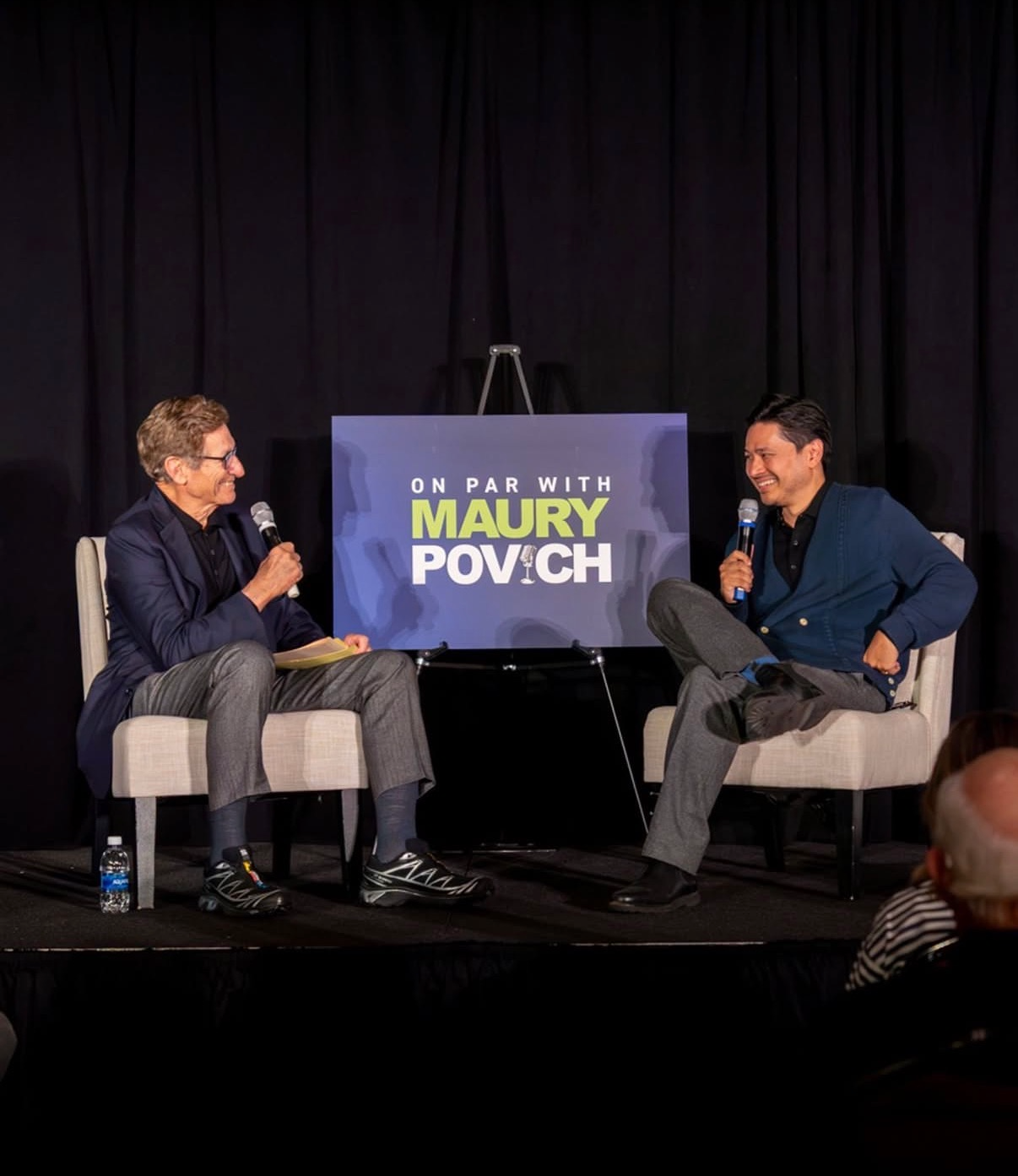
On Thursday, November 5, Pulitzer Prize winner Pablo Torre spoke with Maury Povich at the 20th annual Povich Symposium at the University of Maryland.
The Povich Symposium is hosted yearly by the Shirley Povich Center for Sports Journalism within the Phillip Merrill College of Journalism.
Thursday night’s ceremony marked the 15th anniversary of the creation of the Povich Center in 2011.
Shirley Povich was a majorly influential sportswriter and columnist for The Washington Post, with a career spanning 75 years up until his death in 1998.
The Shirley Povich Center for Sports Journalism was founded in 2011 by Maury, Lynn, and David Povich, the children of the legendary journalist, with founding director George Solomon at the helm. Solomon was an assistant sports managing editor at The Washington Post, and at one point was Shirley Povich’s editor.
Solomon was in attendance on Thursday and after current Povich Center director Mark Hyman, and Merrill College dean Rafael Lorente introduced the event and the speakers, Solomon came up to speak.
The 86-year-old stepped to the stage, and introducing the first speakers of the night,—Maury Povich and Pablo Torre—he made the remark that he had neither heard of nor listened to Torre’s podcast “Pablo Torre Finds Out.”
Other than the comical case of George Solomon, many people in the Riggs Alumni Center on Thursday, sports media industry and viewers around the world have heard of or seen Torre’s work.
On September 3, 2025, Pablo Torre prompted the NBA to begin an investigation of the Los Angeles Clippers and Kawhi Leonard as Torre revealed evidence that the Clippers were circumventing the salary cap and paying Leonard extra money.
Almost exactly a year later on September 2, 2026, the NBA announced the conclusion of their investigation alongside the punishments for the involved parties: five first-round draft picks taken away from the Clippers, a $700,000 fine for Leonard, a one-year suspension and $30 million dollar fine for Clippers’ owner Steve Ballmer.
The whistleblower for this whole operation was none other than the Povich Symposium’s primary guest Pablo Torre. Torre and the staff of his podcast won the 2026 Pulitzer Prize in Audio Reporting for their series exploring the Los Angeles Clippers’ scandal.
Maury Povich, the one on stage with Torre, was not just the son of Shirley, but a well-known American television host and journalist best known for his tabloid talk show Maury.
Yet, before speaking to the Pulitzer Prize winner, Maury Povich took his stand at the podium to make an announcement relevant to Maryland’s students, faculty and alumni, specifically those in the Merrill College of Journalism.
Maury Povich announced his family’s pledge including his two siblings Lynn and David of $1.5 million to the Shirley Povich Center for Sports Journalism. Maury emphasized the family effort between him and his siblings that pushes the Povich Center to thrive and allows for donations such as this one, continually following in the legacy of their memorable father Shirley Povich.
As the presentation continued, the second Torre and Povich sat down together on stage, their chemistry was evident. Sharing laughs over their matching outfits and the experience of meeting each other, the dynamic between the two journalists, both largely influential in their respective eras, was funny and casual.
Torre did not hold back regarding his impressive work in the Clippers’ scandal and the suspicious business and people he was investigating. The first comment from Torre that raised eyebrows in the room was his claim that “intense wealth does not equate to intense competence.” Torre said this while mentioning that the last time he checked, Clippers’ owner Steve Ballmer was the seventh richest person in the world.
Povich and Torre continued to talk about Torre’s podcast, the small team that runs that production, his ongoing investigations and new cases before the presenters opened for questions.
One pattern, however, was that in a symposium for Maryland’s sports journalism center, issues of race, gender, and the way those aspects intersect with covering sports were all talked about in considerable depth.
First Maury Povich said that his father “always believed that sports opened the door into race, into money, into power, into ethics,” and praised Torre for being able to do that well.
He also said that Shirley Povich talked about finding stories in journalism that were like “meal tickets.” Those meal tickets were people or situations that were evidently corrupt or blatantly racist and discriminatory. Shirley Povich, despite the hateful nature of those situations, loved to expose unjust coaches, athletes and individuals as a part of his role as a sports journalist.
Moreover, Torre mentioned the fear it struck in him being a Filipino individual in journalism who was also the first one in his family born in America.
Before exiting the stage, Pablo Torre and Maury Povich embraced and cameras flashed to capture the genuine moment between the two.
Even in an industry such as sports that seems based in entertainment, enjoyment and sometimes harmless fun, Torre and Povich showed that the ideas of social issues and discussions of race and gender will always be prevalent.