

‘A Raisin in the Sun’: How UMD’s cast breathes new life into a Black family’s 1959 story
Long before the first cast read-through, the actors in the University of Maryland’s rendition of “A Raisin in the Sun” had already embodied their characters: an immigrant torn between two worlds, a woman with a habit of tunnel vision and a Black girl coming of age.
The 1959 Lorraine Hansberry play follows a Black family on Chicago’s South Side as they grapple with a life insurance check after their father’s death. Lena Younger, Beneatha and Walter Lee’s mother, dreams of buying a house in the predominantly white neighborhood of Clybourne Park. With their individual hopes and dreams, the family navigates a world that pushes back.
During the third week of rehearsal, which started the week of Oct. 11, only three of five shows were sold out, and the performances were still taking shape. Although the actors were not in costume, they were starting to fully embody their characters. The audience — composed of fellow cast members, understudies and members of the production team — lined up across the mirrored Rever Rehearsal Studio in the Clarice Smith Performing Arts Center on a floor especially made for movement and acting.
The cast looked toward their reflections as temporary tape marked out stage elements. Brown boxes sat nearby, representing the valuables the Younger family would eventually use as they prepared to move into Clybourne Park, Lena’s dream neighborhood. Red tape and stage markers mapped out the space.
On the right, a white director’s book, filled with notes, held the details of a production still coming together. The actors said “line!” when the script slipped from their heads, and the crew sitting in the front middle scrambled to find lines in 3-inch D-ring binders.
Gil Scott-Heron’s spoken-word protest song “The Revolution Will Not Be Televised” played over clips featuring President Donald Trump’s voice during a scene in rehearsal, a choice Director KenYatta Rogers said married the production team’s ideas.
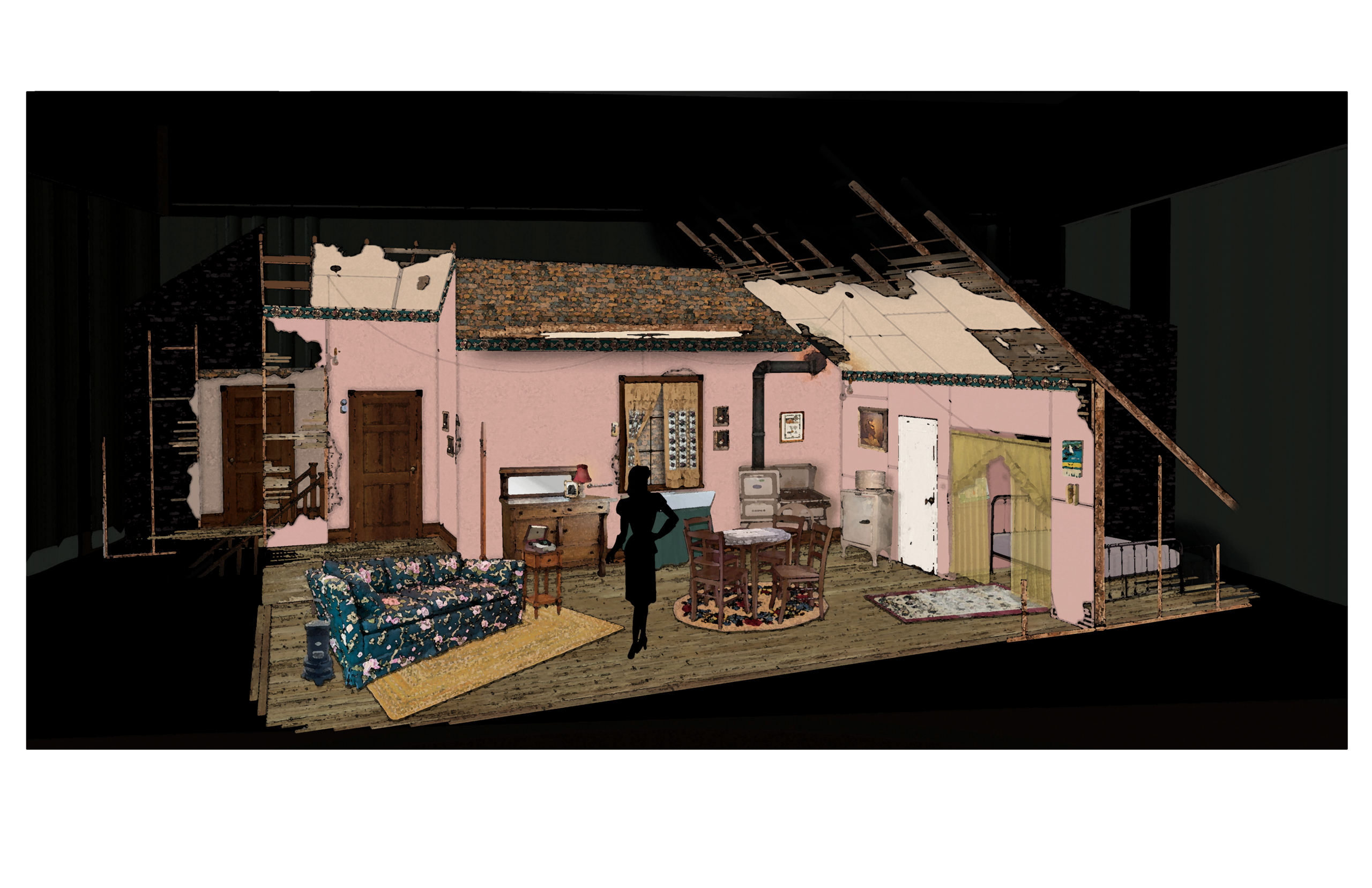
“There’s a scenic design choice from our MFA scenic designer, which has the Younger household kind of on an angle to the audience,” Rogers said. “There’s this kind of blank space that’s left unattended, and it provides so much potential. I was trying to figure out, what is that space?”
That blank space, left by scenic designer Bridgette Tran, became the spot where, during a scene, the actors step toward the audience, abruptly stop and look past the audience’s seating into the abyss.

Rogers said he wanted the moment to “indicate that there was a future beyond the 1950s for the Younger family, the city of Chicago and for American cities that are inhabited by Black and Brown people.”
The mash-up of Scott-Heron and Trump that played during the scene emphasized that the family was making a difficult decision so they could do something “truly revolutionary,” Rogers said.
“That is, to set a course as a family together for something new. However, something new for this family is dangerous and … fraught with … the ability to kind of tear them apart,” he said.
Many cast members cite their personal experience as the strongest toolbox for building their characters.
For Nathan Campbell, the son of two Jamaican immigrants, it was given at birth. He plays Joseph Asagai, a Nigerian peer and suitor to Beneatha Younger. Asagai arrived in the United States at a pivotal moment in the Civil Rights Movement, when Black Americans were striving for equal rights while African nations like Nigeria were pushing for independence from colonial rule. In befriending Beneatha, Asagai introduces her to a new culture. Similar to Campbell, Asagai lives between two realities.
“All of that energy and those feelings that I had growing up, I’m able to breathe into Asagai and really bring those struggles to life,” Campbell said.
Campbell’s relationships with the other actors helped make his acting more natural.
“Being the friend of the actor helps you to be an even closer friend to the character,” he said.
Other cast members also exude life experience into their characters, like Briana Bryant, who plays Beneatha Younger, Asagai’s love interest and Walter Lee’s younger sister. She brought her own ideas to the role. Beneatha is a college student who is curious, restless, relentless and always chasing something new.
“I really relate to Beneatha’s identity as a young woman, especially a young Black woman, just wanting to experience life to its fullest,” Bryant said.
Bryant said she has been told she has the same overwhelming focus or “tunnel vision” as Beneatha, which can cloud her judgment but also fuels her drive to “achieve the things you want to achieve.”
The synthesis of personal experience and creative ambition is evident in other cast members, like Aïda Nyabingi. She plays Ruth Younger, Walter Lee’s wife—the woman who keeps her household running while carrying the weight of her dreams.
“I think there’s a peak of all of them in our natural relationships,” Nyabingi said. “The residue of these characters is already there” when the cast is out of scene.
To Nyabingi, a Maryland native, this show is a senior-year milestone. She is double majoring in theater and anthropology, and wanted a lead role after years of understudying. Nyabingi first eyed Beneatha and was eventually cast as Ruth. Outside the rehearsal room, Nyabingi lives with the actor playing Walter Lee, and she said their friendship poured into the work.
“We’re very much like siblings because we … argue and butt heads a lot,” she said. “I’m like, ‘I told you, I told you to do this,’ and of course, he doesn’t listen to me. So, that’s very similar to Ruth and Walter.”
Rogers told Nyabingi she avoids confrontation when she can. Ruth doesn’t.
“She’s much more snappy. She’s clever,” she said.
In the production, Ruth’s days are a long cycle of work: the morning rush of waking her family up and cooking, then a job away from home. Tran built that routine into the apartment itself. She said she imagined Ruth’s mornings and what the foot traffic could’ve looked like before mocking it up, hoping it would provide a realistic space.
“The Youngers have been in their home for a long time and have settled into a routine that feels choreographed in itself,” Tran said. “There are very specific parts of the floor that have become more scuffed and worn down as a result of being traveled in the same path, in the same order every single day.”
“She’s a realist and has her feet firmly planted on the ground,” Nyabingi said of Ruth. “She just does what needs to be done.”
Ruth “wears the pants,” Nyabingi added. “She is what makes this house go round.”
Nyabingi became an anthropology major after a sociology class bored her. She wanted to learn about culture, backgrounds and people, not numbers or census data.
She said she can realize, “OK, these are the societal and cultural things that characters might have been experiencing that can help inform my performances,” Nyabingi said.
Some of Nyabingi’s other characteristics contrast with Ruth, though; Nyabingi has a “metal face,” as she describes it.
Stepping into a 1950s wardrobe, Nyabingi said, changed how she moved, and the set acted as a catalyst for the characters to come alive.
“Being able to completely strip myself of my style and … become a woman of the ‘50s is such a different experience that it fully fuels the way that I move through the space.”
Eitan Amster plays Karl Lindner, the representative of the Clybourne Park Improvement Association. He said he uses the space to bring him into character.
Amster said Karl starts from a place of anxiety, acting like a “deer in headlights” because he isn’t used to being around Black people.
Before every stage entrance, Amster does something the audience never sees. He rehearses the scene in the hallway, taking deep breaths and looking around at doors, mirroring stepping into a world he’s never been in.
“I’m not even in the room … I am looking around the hall and all the different doors, getting a sense of … what this community looks like,” Amster said.
The costume also helps. In rehearsal, he wears a suit jacket and hat and holds a briefcase.
“It weighs on me, and it adds age,” Amster said.
The costumes also moved other cast members. At a costume parade on Nov. 4, the actors showed each other their finalized costumes. Rogers said the actors lit up when they saw the Younger household that designers had built around them. The costumes blended perfectly with the scenery.
Rehearsals leapt “forward by leaps and bounds just by the actors]= wearing the hair of their character or the glasses of their character or the shoes of their character,” Rogers added.
Stage manager Matt Dietrich saw the change throughout tech week, which ran from Nov. 2 to Nov. 7.
“You see them come alive when they are in costume and … on set,” he said.
Over summer break, when he was told he’d be working on the play, Dietrich read the script, built scene breakdowns, and tagged where cues and moments of intimacy would happen.
“It’s a lot of just prep work to familiarize myself with the script before I even get into the room,” Dietrich said. “The stage manager’s job starts way before people realize.”
When it came time to rehearse, Dietrich taped the designer’s ground plan to the rehearsal room’s floor, marking where furniture like the table, sink, sideboard and refrigerator would be. This allowed the actors to familiarize themselves with the set, he said. While tape marked the furniture, other systems marked where the cast stood.
Soon, Tran’s angled design of the Youngers’ apartment and the empty space beside a couch will have an audience.
“It’s my hope that the audience can walk away with a true and complete knowledge of the Younger family’s pride, resilience, and heart and understand that a family can shape a home as much as a home can shape them,” Tran said
Rogers sees the audience as “the last component” of the production.
“We’re all trying to create a playground to invite the audience into the play-building process,” he said.
On Friday, Nov. 13, when the curtain opens and the lights come up in the Kogod Theatre for a sold-out opening night, the room has to be ready for not just the cast but the Youngers and their new audience. The brown boxes are still there, like the ones that stood in for a family’s life on the rehearsal floor. But this time, they aren’t marked with tape, but are soon to be packed along with the Younger family’s hopes.
“The revolutionary act is to act together,” Rogers said.